Blog

Digital Citizenship

A quick and concise definition of what it means to be a digital citizen
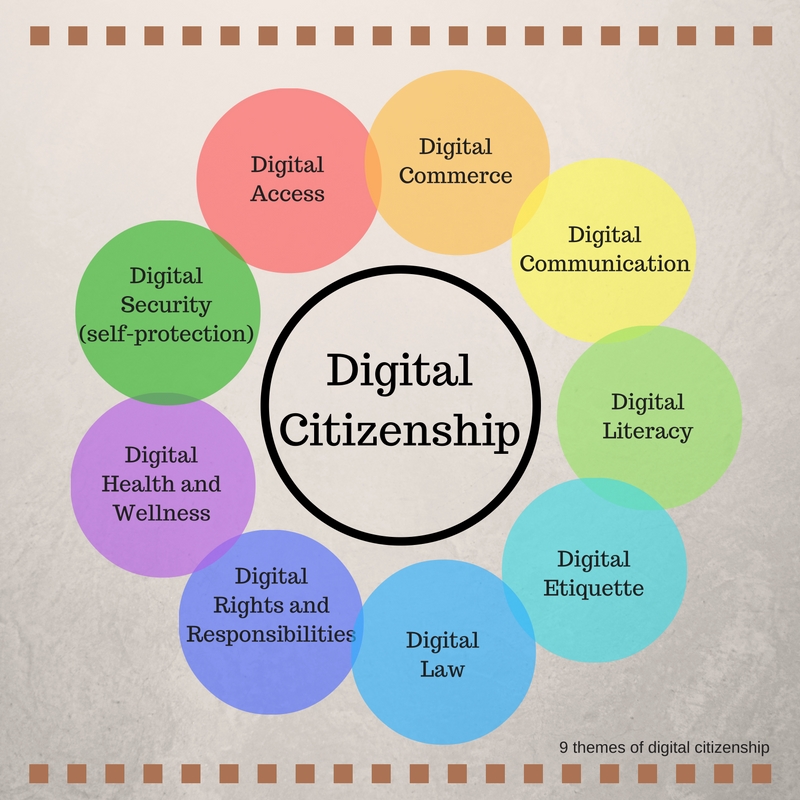
The nine main components of digital citizenship

With digital technology being a predominant part of people’s lives, it is becoming increasingly important that all technology and internet-users understand and practice digital citizenship. A lack of digital citizenship can be demonstrated in a variety of ways such as speaking inappropriately on social media, posting a photo of another person without their permission, speaking informally in a professional email, texting in the middle of a conversation, or having technology and online profiles that are not properly protected. It can also be manifested in much worse ways that can have extreme consequences. Firstly, cyberbullying has justifiably become a major concern for many teachers and parents. A Science Daily article published in 2018 states that, “children and young people under 25 who are victims of cyberbullying are more than twice as likely to self-harm and enact suicidal behaviour.” Secondly, over the past few years we have seen the emergence of online “challenges” which encourage and pressure young and vulnerable people into completing harmful tasks. These have included the Tide Pod, fainting, Blue Whale, and Momo Challenges. With each of these things in mind, digital citizenship is important because it ensures that both ourselves and others are safe and healthy in a digital world. It guides us in acting ethically and responsibly online and can provide young people with the knowledge and skills to make wise decisions when using technology.

As a future teacher, it will be my responsibility to help students navigate the technology that dominates much of their daily lives and in doing so foster digital citizenship. What I have gathered from our class discussions this week and from the resources we have explored, is that digital citizenship cannot be taught in isolation but rather must be continuously integrated into our curriculum. For example, digital etiquette could be discussed in courses like Planning 10 by having students write business emails to potential employers. Digital literacy could be practiced through searching for valuable information online and differentiating between fact and opinion as a part of regular English classes. Digital commerce could be woven into mathematics and projects related to digital health and wellness could be included in Health classes. Digital communication, security, and responsibility could be incorporated into Social Studies classes by having students create Twitter accounts and share their thoughts with classmates via a social media platform. As Lisa Jones and Kimberly Mitchell explain in the article Defining and Measuring Youth Digital Citizenship, it is important to “provide them [students] with interesting opportunities and activities to practice support and respect in their personal online environments” (pg. 13). I hope that in doing so, my students will learn to think critically about both the potential harm and power of technology while learning how to use it responsibly, ethically, and effectively.

To further aid my student in developing digital citizenship, I will stay well-informed and aware of current technological and social media trends through resources such as Common Sense Media. This will allow me to maintain an open and ongoing discourse in my classrooms about digital citizenship based on up-to-date information. Ideally, should an issue arise, students will feel comfortable to seek help from myself or others as a result of this openness.

Social Media in Grade 9 Classrooms

This week we were asked to consider whether or not we would use social media in a grade 9 classroom. As defined by James Surowiecki in The Wisdom of Crowds, social media are “web-based platforms that facilitate collaboration, interaction, and exchange of user-generated content” such as Facebook, Twitter, Instagram, Snapchat, and other similar platforms. A quick Google search of “social media in the classroom” will present you with a number of reasons why it is a helpful teaching tool that can enhance learning. These reasons suggest that it engages and motivates students, increases collaboration, continues this collaboration and engagement outside of the classroom, provides students with a way to keep up with current events, and connects students to a global community. As articulated by the authors of The Journal of Computer Assisted Learning, “integrating these applications into learning and teaching practices has the potential to trigger significant educational innovations as they enable new forms of interactive and collaborative learning.” 

While this all sounds very exciting and useful, my answer to this week’s question is not a simple one. There are also several potentially negative impacts to consider. It provides students with a platform for cyber bullying, can decrease human interaction, can create distractions, and puts students at a risk of seeing inappropriate content. Additionally, if not all students have equal access to technology outside of school, then the introduction of social media to the classroom could create a disparity in educational opportunities. It is also quite likely that under these circumstances, a teacher may assign homework that some students do not have the means to complete which is simply unfair and again, widens a learning gap. 

The writers of Using Sentence Openers to Foster Student Interaction in Computer-Mediated Learning Environments argue that “just as the classroom needs its teacher, social media spaces require a skilled moderator for effective learning to occur during the collaborative knowledge creation process.” I would agree and suggest that before teachers integrate social media into their classrooms, they first question if they have the skills and knowledge to be this moderator and ensure the social media is used in an intentional, effective, equal, and safe way. If the teacher is capable of this, then I believe that the use of social media in a grade 9 classroom could be very beneficial. Not only could it increase engagement and enhance learning, but also provide teachers with an opportunity to have a conversation with students about social media use. According to a 2014 Daily Mail article, “children are most likely to post an image or video of themselves online or set up a fake profile for the first time at the age of 11, try Twitter and message a stranger at 12 and try services like SnapChat and Ask.fm at the age of 13.” Based on this information, it is evident that grade nine students will likely be experiencing the negative impacts of social media in their lives regardless of it’s use in the classroom, so teachers may as well use the opportunity to have this conversation and help students navigate the digital world of social media in a way that may actually enhance their lives and learning.

Google Hangouts Tour

This week in EDTC 300 we explored some of the many ways teachers can use Google Apps in the classroom. We then had to create a short video tutorial for a Google App. I chose Google Hangouts because I think this app in particular could be beneficial for teachers working in rural communities. Hangouts could be used to have guest speakers “visit” the class from anywhere in the world. This would provide students the opportunity to meet and speak with people they would not otherwise be able to due to their location. This is essentially substitution on the SAMR matrix as it simply replaces having guest speakers visit the class in person. However, since it provides the potential to have experts from a variety of fields and places share their knowledge with students, I believe it has merit. Of course there may be obstacles such as connectivity that should be considered before utilizing this technology in a classroom.

It’s All About Balance

In 1973, Yukon First Nations presented a “statement of grievances and an approach to settlement” to the Federal Government in a document called Together Today for our Children Tomorrow. In appendix one (page 49) they provide twelve recommendations regarding education in the Yukon. Each of these recommendations was given to help ensure that First Nations ways of knowing and doing are reflected in our schools. When implemented, they help decolonize education and create a positive school experience for First Nations peoples that prepares them to be successful in a changing world. This ambition to decolonize education must be considered as we contemplate the effectively use of technology in classrooms.

One of the major characteristics of decolonizing education in the Yukon requires teachers to foster a deeper connection to the land, people, and language amongst their students and to provide opportunities for their students to enhance this connection. In the short video “Practical Decolonization”, Taikaike Alfred, a professor of Indigenous governance at the University of Victoria, says that “the only way to restore that [the souls of Indigenous peoples], to make it full and whole again is to put them back into connection with the land.” He explains that when First Nations peoples spend time on the land with their own people and speaking their own language, physical health is re-established, the community becomes unified, people inherently become more cultured, and what colonization took away is restored. These sentiments were echoed in our classroom last week by our guest speaker from Yukon First Nations Programs and Partnerships. He agreed that this connection to land and to one another is essential for First Nations students and spoke about the benefits of a five-day, technology-free, on the land field trip. 

Arguably, digital technology does the opposite of foster deep, meaningful connections to place and people. For this reason, teachers need to think critically about the utilization of technologies in Yukon classrooms and question how it may hinder our goals to decolonize education by potentially increasing disconnection. This is not to suggest that there is no place for technology in our schools. In fact, I believe that to prepare students to be successful in a technological world, teachers need to ensure student develop the skills to use technology effectively. This week we have been exploring the many ways technology can enhance learning and allow us to redesign old tasks as well as create new ones which I think can be hugely beneficial. However, there must be a balance. 

For example, we are currently seeing the development of language apps for several Yukon First Nations languages. This will make memorizing new words and phrases much easier as it allows learners to hear the words repeated as many times as needed, which would not otherwise be possible. This is helpful, but because there is no growth in connection to people when learning through an app, it should be used a supplement. Another example is that of the technology-free field trip. Perhaps this balance could be achieved by ensuring technology is used at appropriate times such as in the classroom for specific tasks, but then fully omitted when the opportunity to gain deeper connections occurs such as when on the land or in the presence of guest speakers.

I hope to achieve this balance in my teaching practice and in doing so, find my “pedagogical peace.”  

Pedagogical Peace

Neil Postman uses the term “pedagogical peace” in his book, Technopoly. This term nicely describes one of my main teaching aspirations which is to provide my students with a harmonious balance between the many things they need in order to succeed. This is particularly complex in the Yukon as teachers are expected to use the digital technology provided to them while also carefully considering the way in which this technology contributes to, or rather hinders, our goals to decolonize education and allow our students to engage in relevant curricula and content. The need for this pedagogical peace is brought to light in many of the critical perspectives we have explored over the past two weeks of EDTC300. My next blog post will focus on the part that First Nations knowledge and traditions play in this pedagogical peace, while this post looks at educational technology in a broader sense. 

In 1992 Postman wrote that “it is a mistake to suppose that any technological innovation has a one-sided effect” (pg. 4). 27 years later, as we live in a society with such a strong presence of digital and communication technologies, this sentiment is incredibly important for teachers to know and understand. While these kinds of technologies can be hugely beneficial in increasing student engagement and opening up a world of new possibilities for teaching and learning, we must not only think about what is being given. We must also ask ourselves what the introduction of new technologies in a classroom may be taking away.

I attended high school in a rural community and hope to teach in rural communities, so I often find myself relating ideas, concepts, and thoughts back to this kind of school environment. Shortly after I graduated, my high school switched to mostly online classes. The benefit of this technology was that students could have a larger range of electives to choose from and could take courses at the correct time based on their grade level rather than whenever they were being offered (as some courses might not be offered again before they graduate if not enough students needed that required course). This is arguably quite logical, however, imagine a high school experience without any discussion. A student sitting in front of a computer and learning in solitude is not gaining skills in critical thinking as they have no opportunity to ask questions. They are also robbed of any opportunities to have human interaction and form deeper connections with their classmates, teachers, or environment. We have spoken in depth this week about how technology is ideological in that it changes the way we think and interact with one another. I would agree and venture to say that a high school student who takes mostly online courses would in fact think and interact differently than a student who attends classes with other living and breathing human beings.

Looking at just this one example, we can already understand Postman’s reason for saying that “when we admit a new technology to the culture, we must do so with our eyes wide open” (pg. 7). When digital and communication technology is used in a classroom, we as teachers must first think deeply about the benefits and the detriments, the positive and the negatives. I hope that with the knowledge and understanding gained from this course I can be teacher who uses technology intentionally and effectively as a supplement to my teaching and certainly not as a replacement.